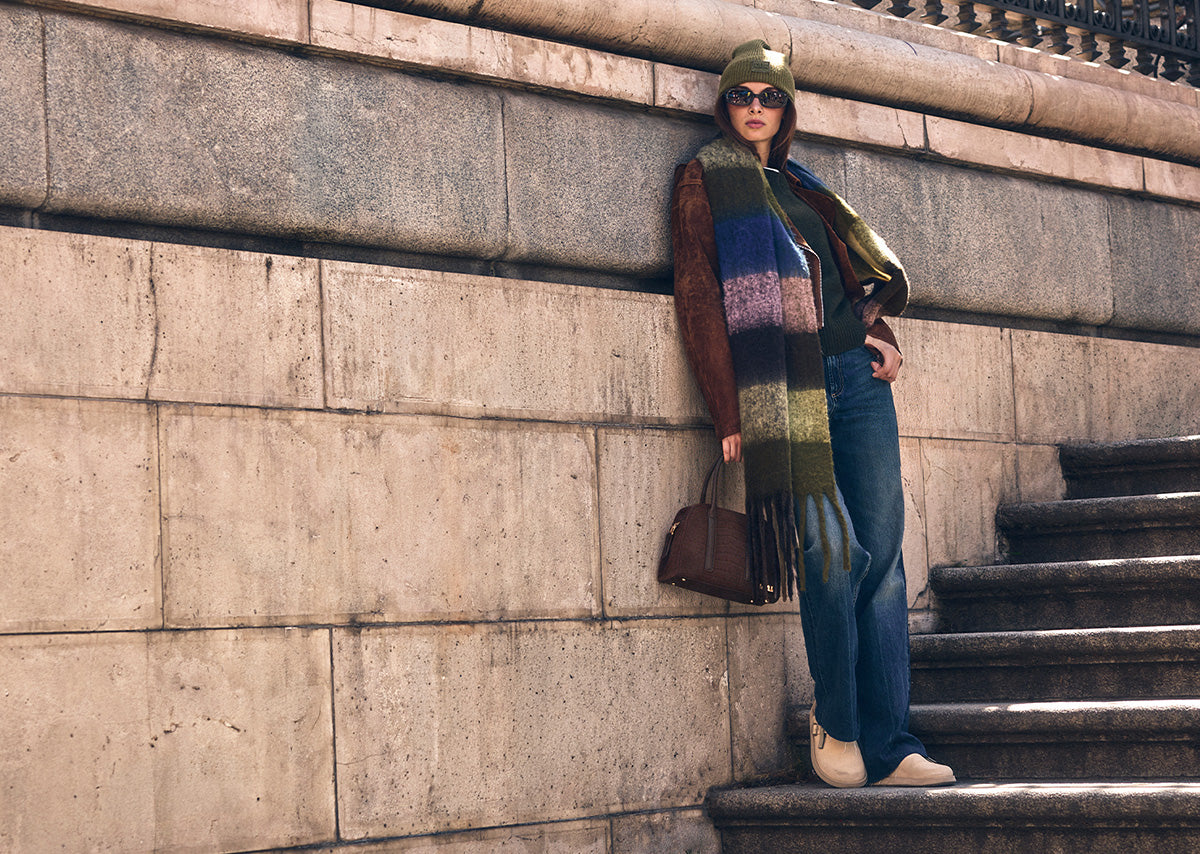
Women's scarves are much more than an accessory for the cold. A good scarf keeps you warm, gives structure to your look and says something about you. With one, a pair of jeans and a basic jumper become an outfit with intent. Here we explain the types available, how to choose yours, how to wear it and how to pair it with your jewellery.
Why a scarf makes all the difference to your outfit
A well-chosen women's scarf does three things at once:
- It keeps your neck warm, one of the areas where you feel the cold most.
- It structures the look: it balances silhouettes and softens very straight lines.
- It adds colour and texture close to your face, which is key if you tend to wear neutral tones.
It also lets you play with layers without changing your whole outfit. With the same coat and a different scarf, the look changes completely.

Types of scarf worth having
You don't need ten styles. With three or four well-chosen types of scarf, you can cover almost any situation without filling up your wardrobe.
Oversized scarf
Big scarves work as a light layer, a travel blanket and a statement piece in city looks. They're perfect if you get around on public transport or spend long hours in air-conditioned places.
Key points when choosing an oversized scarf:
- Long enough to wrap around at least twice without feeling bulky.
- A fabric with body, which holds its shape when knotted without feeling stiff.
- Neutral colours (camel, grey, black, ecru) if you want it to go with almost everything in your wardrobe.
Foulard or lightweight scarf
The foulard is the go-to option when you want something light that adds colour or print without adding bulk. In between seasons it keeps you just warm enough, and in summer it protects you from the breeze without making you hot.
It works best with:
- Blazers and straight-cut coats.
- Office looks, where a very chunky scarf would break the line.
- Looks with jewellery around the neck, because it doesn't cover it completely.
Tube scarf or snood
The tube scarf, also known as a snood or neck warmer, is closed. You put it on and take it off in a second, it doesn't come undone and it doesn't get in the way if you're carrying a backpack or a crossbody bag.
It's the obvious choice for:
- Days of quick errands.
- Plans where you'll be taking your coat on and off a lot.
- Sporty or urban looks with trainers and jeans.
Bandana
A small scarf worn knotted around the neck, in the hair or even tied to the handle of your bag. It's not for intense cold, but it adds a touch of colour in between seasons and in casual looks.
The most popular scarf prints and finishes
Beyond size, the design sets the character of the scarf. These are the most versatile finishes:
- Check: checked scarves are a winter classic. They go with plain coats and add a British or preppy feel.
- Stripes: striped scarves bring energy and look great with simple outfits.
- Fringe: fringed ends add movement and a more relaxed touch.
- Plain: the easiest option to pair and the best base if you're already wearing statement jewellery or bags.

How to choose the scarf that suits your style
Before adding another winter piece, think about three things: colour, texture and proportion. It's the same thing you do when choosing between a necklace and a bracelet, but applied to fabric and volume.
The key is for the scarf to work with what you already have. If your wardrobe is full of plain basics, you have room for prints and bold colours. If you already wear plenty of statement bags, rings and earrings, go for something cleaner.
Based on your colour palette
If you find it hard to move away from black but want a scarf with personality, go for warm neutrals or deep tones:
- Brown scarves, camel or hazelnut: they add warmth and go with almost everything.
- Red scarves or wine tones: an elegant touch of colour.
- Green scarves, such as olive or bottle green: they add visual richness without being loud.
If you'd rather play it safe, black scarves are the easiest base to pair.
If you already wear a lot of colour, look for a shade you repeat often in your outfits: for example, the blue of your jeans with a blue scarf. That way you create continuity and avoid that pretty piece you never know what to wear with. And if you like to take risks, colourful scarves are the perfect accessory to liven up a neutral coat: pink scarves brighten your face and orange scarves add energy to darker looks.
Based on your silhouette and your coat
Straight coats with wide lapels look great with oversized scarves: the volume balances the structure. On the other hand, a cropped biker jacket or a denim jacket calls for less bulky scarves so as not to break the line.
If you have narrow shoulders, look for fabrics with some body, which hold their shape and add volume to the area. If your shoulders are broad, a soft texture with drape helps to soften them.
Based on how you'll use it
Think about where you'll really wear the scarf. Walking to work is not the same as going from the car to the office. In the first case, coat and scarf take centre stage. In the second, they're almost a formality.
If you're barely outdoors, prioritise lightweight scarves you can also wear indoors. If you spend many hours outside, a good oversized scarf is more worthwhile. In the end, the best scarf is the one you actually wear.
How to wear a scarf: 4 easy ways
The way you tie your scarf completely changes the result. These are the simplest:
- Simple loop: wrap it around your neck once and let both ends hang down the front. It's the quickest and works well with open coats.
- Parisian knot: fold the scarf in half, put it around your neck and pull the ends through the loop. It's warm and looks neat.
- Double wrap: wrap it around your neck twice and leave the ends loose or tucked in. Ideal for oversized scarves and very cold days.
- Over the shoulders: open out the big scarf and wear it like a shawl. It works indoors and with dressier looks.

How to pair a scarf with jewellery and accessories
A scarf sits very close to your face, just like your jewellery. Coordinating them elevates the look without any fuss.
Think of the scarf as a textile base you build on with earrings, necklaces, sunglasses and rings. By changing those four elements, the same coat tells different stories.
With earrings and piercings
With a bulky scarf, small earrings disappear. Medium hoop earrings, geometric designs or drop earrings work better, as they stand out from the fabric.
Ear piercings really shine with your hair tied up and the scarf framing your face. The contrast between the soft fabric and the shine of the metal works without the need for bold colours.
With necklaces
Necklaces sit well with lightweight scarves or knots that show part of the neckline. With an oversized scarf closed at the neck, they get covered and lose their point. The same goes for chokers.
A tip for indoors: take off your scarf and let the necklace take centre stage. If the necklace is a chain-link or rigid design, a soft-touch scarf balances the materials.
With sunglasses and rings
Sunglasses and rings don't compete with the scarf for space, but they do compete for attention. Sunglasses with a strong shape, such as cat-eye, aviator or butterfly frames, turn a basic scarf into part of a very defined look.
Rings stand out when the scarf leaves your hands free. If your jumper peeks out from your coat sleeve, a mix of metals and shapes on your hand, with a silver ring or two, completes the outfit without overdoing it.
Scarf materials and how to care for them
Just as gold-plated jewellery needs some care, your scarf also appreciates a little attention. Knowing what to expect from each fabric helps you choose better.
Common fabrics and what to expect from each
| Fabric | The best | Bear in mind |
|---|---|---|
| Wool blends | Very warm and hold their shape | Can itch if the fibre isn't well treated |
| Acrylic | Light, soft and durable for everyday use | Can pill with friction |
| Polyester | Durable, quick-drying and lightweight | Less warm than natural fibres |
Acrylic and polyester blends offer a good balance between price, care and durability for everyday city use. They don't match the feel of premium fibres, but they're very practical.
How to wash and care for a scarf
- Air it out after wearing. This avoids unnecessary washes, which are what wear the fabric out the most.
- Only wash it when needed, for example if it has visible stains.
- Cold water and a delicate cycle, or hand wash for the most delicate fabrics. Always follow the label.
- Dry it flat so it doesn't lose its shape, like any knitwear.
- Store it with nothing on top so it keeps its volume and shape.
How to build a small capsule scarf wardrobe
The same logic as your jewellery box applies to your scarves: better a few well-thought-out pieces than a drawer full of options you never use.
A good starting point is three styles:
- A neutral oversized scarf for truly cold days.
- A lightweight coloured or printed scarf to bring your looks to life.
- A practical snood for busy days.
If you already go for design-led costume jewellery and bags with personality, don't leave your scarf to chance either. Think about which textures go with the metals you usually wear and which colours complement your key pieces. And if you want to play it safe, winter sets give you a hat and scarf that are already coordinated.
Frequently asked questions about women's scarves
What's the difference between a scarf and a foulard?
A scarf is usually thicker and longer, designed to keep you warm. A foulard is a fine, lightweight scarf, more decorative, worn mainly in between seasons.
Which type of scarf is the warmest?
An oversized scarf in a fabric with body, especially a wool blend, worn wrapped twice around the neck.
What colour scarf goes with everything?
Neutrals: black, grey, camel and ecru. If you want some colour without overthinking it, brown, olive green and wine tones are also very easy to pair.
How do I wear a checked scarf?
With plain coats and jumpers. Pick one colour from the scarf and repeat it in another garment or accessory to tie the look together.
How often should you wash a scarf?
Only when it needs it. Airing it out after each wear is usually enough, and that way the fabric wears out less.
How do I stop my scarf from pilling?
Wash it inside out on a delicate cycle and don't mix it with rough garments. Also avoid constant friction with your bag strap.